Logistics has always been a game of margins — a few minutes saved on a route, a few dollars shaved off a shipment, a single missed delay avoided. What has changed is how those margins get found. Today, they are uncovered not through instinct or experience alone, but through data. At Cenntrax, we believe this shift is not a trend — it is the new foundation of competitive logistics.
From Guesswork to Ground Truth
For decades, logistics decisions were often made on gut feeling: a dispatcher's sense of which route usually works, a warehouse manager's estimate of peak demand, a planner's rough forecast for the next quarter. These instincts were valuable, but they were also limited — built on partial information and past experience that doesn't always predict the future.
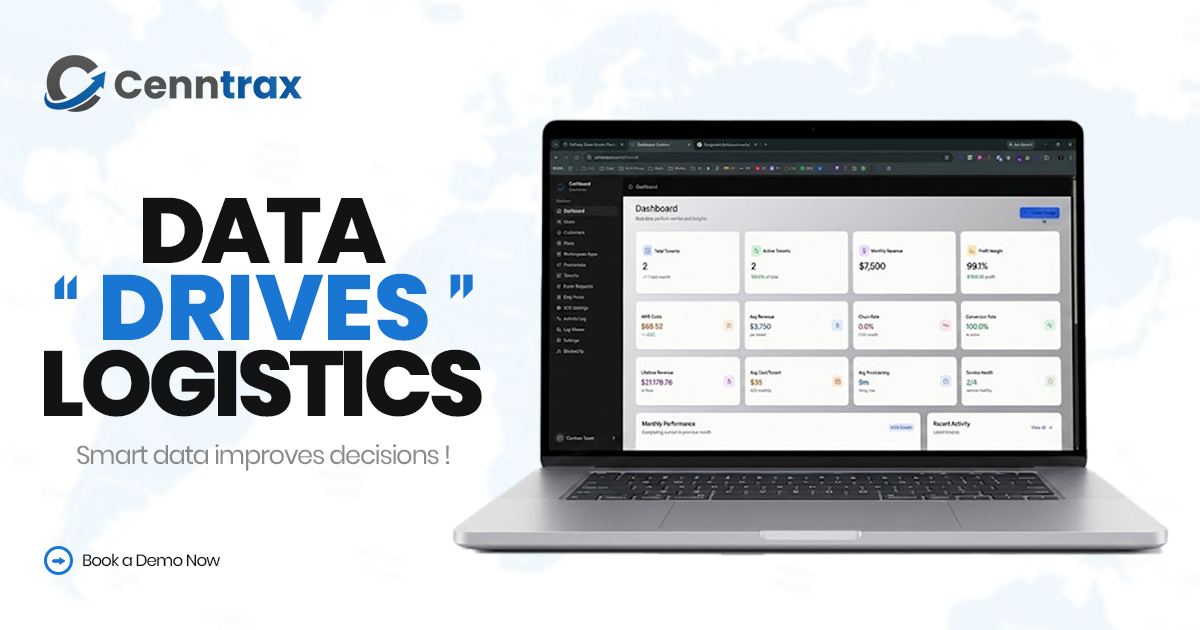
Smart data changes that equation. When every shipment, vehicle, warehouse, and delivery generates a trail of information, logistics teams no longer have to guess. They can see, in real time, exactly what is happening across their network — and use that visibility to make sharper, faster, more confident decisions.
Where Smart Data Makes the Biggest Difference
Route optimization. Traffic patterns, weather conditions, fuel costs, and delivery windows all shift constantly. Data-driven routing engines process these variables continuously, adjusting paths in real time rather than relying on a static plan set once a week.
Demand forecasting. Historical sales data, seasonal trends, and even social or economic signals can be combined to predict demand spikes before they happen. This means fewer stockouts, less overstock, and warehouses that are staffed and stocked for what's actually coming.
Fleet and asset management. Sensors and telematics data reveal how vehicles are actually performing — fuel efficiency, maintenance needs, idle time — allowing companies to act before small issues become costly breakdowns.
Risk and disruption management. Global supply chains are vulnerable to disruption, from port delays to weather events. Data pulled from multiple sources — supplier status, geopolitical news, transportation networks — gives logistics teams early warning and time to reroute before a small disruption becomes a major delay.
The Cenntrax Approach
At Cenntrax, we see data not as an add-on to logistics operations, but as the operating system underneath them. Our approach centers on three principles:
Visibility first. Decisions are only as good as the data behind them. We prioritize clean, connected, real-time data across every stage of the supply chain.
Actionable insight, not just information. Raw data is noise until it's turned into a clear recommendation. Cenntrax focuses on translating complex data streams into decisions people can actually act on.
Continuous improvement. Logistics never stands still, and neither should the data behind it. We treat every shipment as a learning opportunity, refining models and forecasts as new information arrives.
Why This Matters Now
The pressure on logistics networks has never been higher. Customers expect faster deliveries, tighter windows, and full transparency. Costs are rising, and margins for error are shrinking. In this environment, companies that rely on outdated methods — static schedules, manual forecasting, siloed information — are at a structural disadvantage.
Companies that embrace smart data, on the other hand, gain a compounding advantage. Every decision informed by real data makes the next decision easier and better. Over time, this creates a level of operational precision that instinct alone simply cannot match.
Looking Ahead
The future of logistics belongs to organizations that treat data not as a byproduct of operations, but as the engine driving them. At Cenntrax, we're committed to helping logistics teams unlock exactly that — turning scattered data points into clear, confident, smarter decisions, shipment after shipment.
Because in logistics, the companies that see clearest, move fastest.