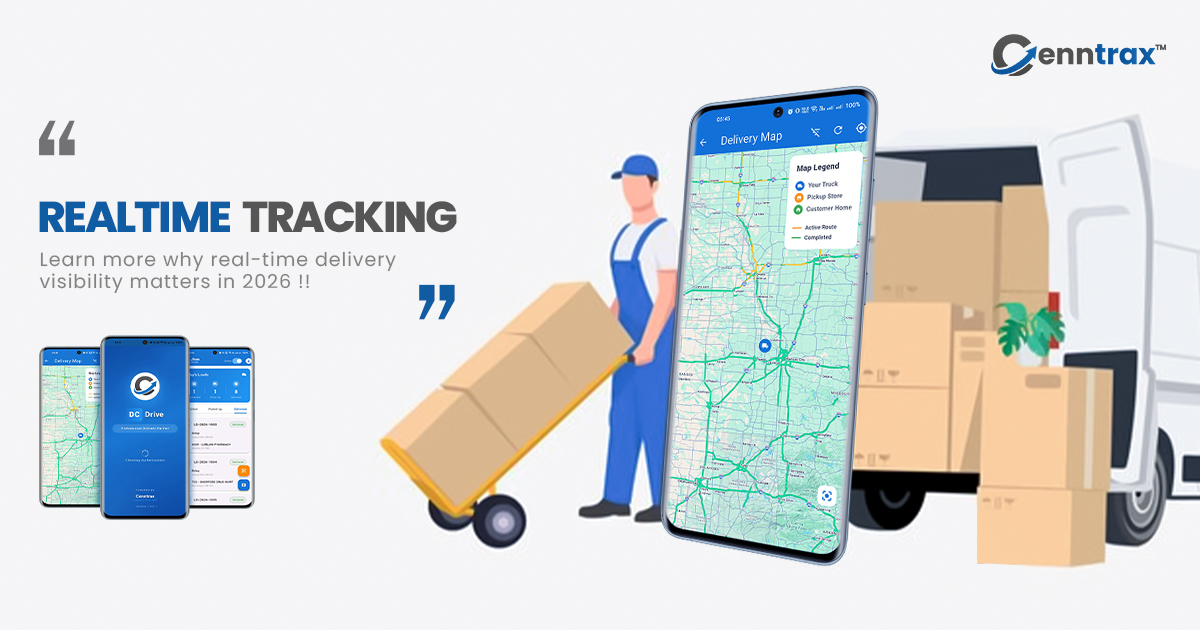
Customer expectations have fundamentally shifted. The ability to track packages in real-time is no longer a nice-to-have feature—it's the baseline expectation. In 2026, customers expect to know exactly where their deliveries are, when they'll arrive, and whether delays will occur. Companies that fail to provide this visibility face customer dissatisfaction, negative reviews, and lost business to competitors who do. At Cenntrax, we've helped logistics companies implement real-time tracking systems that transform customer experience and operational efficiency. Here's why real-time visibility matters now more than ever.
The Shift in Customer Expectations
The rise of e-commerce giants offering real-time package tracking has reset customer expectations across all logistics sectors. Customers who can track Amazon packages in real-time expect the same visibility from regional delivery companies, local couriers, and specialized logistics providers.
From Opacity to Transparency
Just five years ago, many customers considered themselves lucky to receive a delivery within a promised day. Today, customers expect precision—not just the day but the hour, ideally the minute.
This shift creates a competitive imperative. Companies providing real-time visibility gain customer loyalty and positive word-of-mouth. Companies that don't provide visibility lose customers to competitors who do. The visibility gap has become the competitiveness gap.
The Anxiety of Uncertainty
Customers naturally feel anxious when they don't know where their deliveries are or when they'll arrive. That anxiety translates into phone calls asking "where's my package?" repeated hundreds of times daily for mid-sized logistics companies. These calls waste customer service resources and frustrate customers forced to play detective.
Real-time tracking eliminates this anxiety. Customers can see exactly where their delivery is, reducing uncertainty and the accompanying stress. Fewer calls mean more efficient customer service operations focused on genuinely complex issues rather than basic status inquiries.
The Trust Factor
Companies that provide transparency earn trust. Customers who can see real-time progress believe the company is competent and professional. Companies that can't provide visibility appear disorganized or intentionally withholding information—neither impression builds trust.
In 2026, trust is a primary customer loyalty driver. Real-time tracking builds trust more effectively than any marketing message ever could.
Operational Benefits Beyond Customer Service
While customer satisfaction is important, real-time tracking delivers even more significant operational benefits.
Proactive Problem Management
With real-time visibility, problems don't surprise you—they become apparent as they develop. A driver is running significantly behind schedule? You see it developing and can notify affected customers proactively rather than having them discover missed delivery windows. A vehicle breaks down unexpectedly? You see it immediately and can reassign its deliveries to other drivers.
Manual dispatch or basic GPS without real-time analytics makes you reactive—problems are identified after they've already occurred and caused customer dissatisfaction. Real-time tracking makes you proactive—problems are identified and addressed before they escalate.
Cenntrax clients report that proactive communication about delays reduces customer complaints by 40-60% compared to reactive communication after delays occur.
Dynamic Route Optimization
Real-time tracking combined with route optimization enables continuous dynamic adjustments. An unexpected delay for one vehicle? The system reassigns its downstream deliveries to unaffected vehicles. A customer calls requesting expedited delivery? The system determines which vehicle can feasibly add the delivery and routes it optimally.
These dynamic adjustments are impossible without real-time visibility. Manual dispatch can't respond to real-time situations fast enough to optimize. By the time a dispatcher identifies a problem and recalculates routes, opportunities for optimization have passed.
Driver Performance Insights
Real-time tracking captures objective data on driver performance—actual routes driven versus planned, actual delivery times versus estimated, idling patterns, harsh acceleration or braking events, and time spent at each stop.
This data enables coaching. Drivers whose actual performance differs significantly from expected can receive targeted feedback. High-performers can be recognized and incentivized. Safety issues can be addressed before they result in incidents.
Without real-time tracking, performance management relies on subjective assessments and customer complaints. Objective data enables fair, fact-based performance management.
Exception Identification and Analysis
Real-time tracking generates vast data on what's working and what isn't. The system identifies exceptions—deliveries taking longer than expected, specific locations consistently causing delays, times of day when performance degrades, or drivers whose performance significantly differs from peers.
These exceptions point to improvement opportunities. A delivery location consistently taking longer than expected might require different approach or staffing. A time period consistently underperforming might indicate traffic patterns affecting planning. A driver's poor performance might reflect specific challenges you can help with.
Without this data, you operate on assumptions. With it, you make decisions based on evidence.
Customer Service Transformation
Real-time tracking doesn't just meet customer expectations—it transforms customer service operations.
Reduction in Status Inquiries
Without real-time tracking, customers call asking where their deliveries are. With it, they check the tracking system. This shift eliminates the largest category of customer service calls—basic status inquiries.
Cenntrax clients implementing real-time tracking typically report 35-50% reduction in inbound customer service calls. That's not a minor reduction—it's transformative for customer service staffing and costs.
Empowered Customer Service
When status inquiries are eliminated through self-service tracking, customer service teams focus on genuinely complex issues—damaged shipments, failed deliveries, special requests, or billing questions. These are issues that require human problem-solving rather than information retrieval.
Customer service quality improves because representatives have time for meaningful interactions rather than being buried in routine status calls.
Proactive Communication Advantage
With real-time visibility, you can contact customers proactively before they contact you. A delivery is running late? Notify the customer before they call asking for status. A delivery failed because the address was inaccessible? Contact the customer immediately with a proposed resolution.
Proactive communication creates the perception of excellence. Customers feel the company is on top of situations and communicating transparently. This dramatically improves satisfaction even when problems occur—the difference between discovering a problem yourself versus being notified by the company is enormous.
Accountability and Transparency
Real-time tracking creates an environment of objective accountability that benefits everyone.
Unambiguous Performance Records
With real-time tracking, there's no ambiguity about what happened. Did the driver attempt delivery? Is there a photo and timestamp proving it? Did weather conditions prevent delivery? Is there data showing the timeframe and conditions? Were deliveries made in the promised sequence and timeframes?
Objective records eliminate he-said-she-said disputes. When a customer claims their package was never delivered, you have data showing whether it was. When a driver claims traffic caused lateness, you have data showing actual conditions and performance.
This accountability protects everyone. Drivers' performance is judged on objective data, not customer perceptions. Customers can see what actually happened. The company makes decisions based on facts, not guesses.
Building Driver Relationships Through Trust
Drivers appreciate clear performance standards backed by objective data. When performance management is based on GPS data rather than customer complaints, drivers understand what's expected and can work to improve specifically. The relationship becomes collaborative problem-solving rather than adversarial blame assignment.
Cenntrax has observed that companies implementing transparent, data-based performance management report better driver retention and higher driver satisfaction.
Competitive Necessity in 2026
In 2026, real-time tracking has shifted from competitive advantage to competitive baseline. Competitors likely offer it. Customers expect it. Not providing real-time visibility increasingly means losing business to companies that do.
The Expectation Ratchet
Customer expectations only increase. Today's baseline is tomorrow's minimum. A company that matches competitors' real-time tracking today will find customers demanding more advanced features tomorrow—predicted delivery within 15-minute windows, live video of delivery attempts, or real-time communication with drivers.
The competitive reality is that you must constantly evolve capabilities to maintain parity with competitors.
Market Share Risk
In industries where multiple companies compete for the same customers, visibility advantage directly translates to market share. Customers choosing between logistics providers with equivalent pricing and service terms often choose based on visibility and communication capabilities.
Cenntrax has observed market share losses for clients that delayed implementing real-time tracking while competitors moved forward. Catching up after you've lost market share to competitors is harder than maintaining it through equal capabilities.
Implementation: Making Real-Time Tracking Work
Real-time tracking requires more than just GPS devices on vehicles. It requires integration of tracking technology with dispatch systems, customer communication platforms, and performance analytics.
Technology Architecture
At Cenntrax, we implement comprehensive real-time tracking that includes GPS-enabled devices on every vehicle, continuous location updates (not just periodic snapshots), integration with route optimization for real-time dynamic adjustments, automated customer notifications triggered by events, driver interface showing real-time optimization and instructions, and comprehensive analytics on performance and exceptions.
This integrated approach delivers the full value of real-time tracking rather than limited visibility from basic GPS alone.
Data Privacy and Security
Real-time tracking captures sensitive data—location information revealing where people work and live, personal schedules, and behavioral patterns. Protecting this data is both ethical obligation and legal requirement. Cenntrax systems incorporate security by design—encrypted data transmission, secure authentication, role-based access controls, and compliance with privacy regulations.
Customers trust companies that handle tracking data responsibly. Security isn't optional—it's foundational.
Customer Communication Strategy
Providing real-time tracking is only valuable if customers actually use it. Effective implementation requires clear communication about how to access tracking, what information is available, how to interpret it, and how real-time visibility benefits them. Some customers need training. Others need reassurance that location tracking respects privacy. Still others simply need to know the feature exists.
At Cenntrax, we help companies develop customer communication strategies ensuring that real-time tracking capabilities translate to actual customer usage and satisfaction.
A Cenntrax Client Success Story
A regional delivery company with 45 vehicles and 120 daily deliveries implemented real-time tracking with Cenntrax. Previously, customer service received 200-250 calls daily, primarily status inquiries. Deliveries regularly occurred outside promised windows due to lack of visibility into actual progress.
After implementing Cenntrax real-time tracking with integrated dispatch and customer notifications, dramatic improvements occurred:
Customer Service Call Volume: Decreased 42% as customers accessed real-time tracking instead of calling for status.
Delivery Window Performance: Improved from 68% on-time to 91% on-time through visibility enabling proactive adjustments.
Customer Satisfaction: Increased 35% primarily due to visibility and proactive communication about delays.
Operational Efficiency: Improved 18% through data-driven identification of performance improvements.
Driver Satisfaction: Improved significantly through transparent, objective performance management.
The company gained competitive advantage, improved profitability through operational efficiency, and enhanced growth capacity. Success compounds—improved reputation drives more customers, which creates more data enabling better optimization.
Looking Forward: 2026 and Beyond
Real-time tracking technology continues evolving. Integration with AI enables predictive ETAs accounting for traffic patterns, weather, and other factors with accuracy previously impossible. Augmented reality features may enable drivers to see delivery instructions overlaid on physical locations. Autonomous vehicle integration will make real-time tracking even more central to operations.
Companies establishing real-time tracking excellence today position themselves to leverage future capabilities more effectively than those struggling to catch up.
Common Implementation Concerns
"Drivers will resist tracking." Drivers typically appreciate real-time systems because they eliminate ambiguous performance disputes and enable objective feedback. Transparency works both ways—it protects drivers as much as it protects the company. Cenntrax has observed that driver resistance diminishes dramatically once systems are implemented and drivers experience the fairness of objective performance management.
"Data volume will overwhelm our systems." Modern systems are designed to handle massive data volume efficiently. At Cenntrax, we design scalable architectures handling data from thousands of vehicles without performance degradation.
"Implementation will disrupt operations." Phased implementations minimize disruption. Cenntrax typically runs real-time tracking in parallel with existing processes initially, transitioning gradually as teams become comfortable with new systems. Most deployments complete within 30-60 days with minimal operational disruption.
"Integration with existing systems will be complex." Modern systems integrate with most common dispatch and business systems. Cenntrax specializes in integration, handling compatibility challenges and ensuring seamless operation across systems.
The Cenntrax Real-Time Tracking Advantage
At Cenntrax, we provide comprehensive real-time tracking that integrates with dispatch optimization, customer communication, and performance analytics. Our approach delivers complete visibility enabling better decisions across operations, customer service, and strategic planning.
We don't just track vehicles—we provide visibility that transforms your entire operation.
Conclusion
Real-time delivery visibility is no longer optional in 2026. Customer expectations demand it, competitors likely provide it, and operational benefits justify the investment. Companies that haven't implemented real-time tracking are operating at significant disadvantage.
The good news is that technology is mature, implementation is straightforward, and ROI typically appears within months. The question isn't whether to implement real-time tracking but how to do it effectively to capture maximum value.
Real-time visibility enables better customer service, more efficient operations, objective performance management, and data-driven decision-making. These capabilities compound into sustained competitive advantage.
Don't let your logistics operation operate blind. Real-time visibility is the foundation of modern logistics excellence.
Ready to implement real-time tracking for your logistics operation? Contact Cenntrax for a free tracking capability assessment. We'll evaluate your current visibility gaps, quantify the operational and customer service improvements real-time tracking would deliver, and develop a practical implementation roadmap. Let's transform your operation with the visibility your customers expect and your business needs.