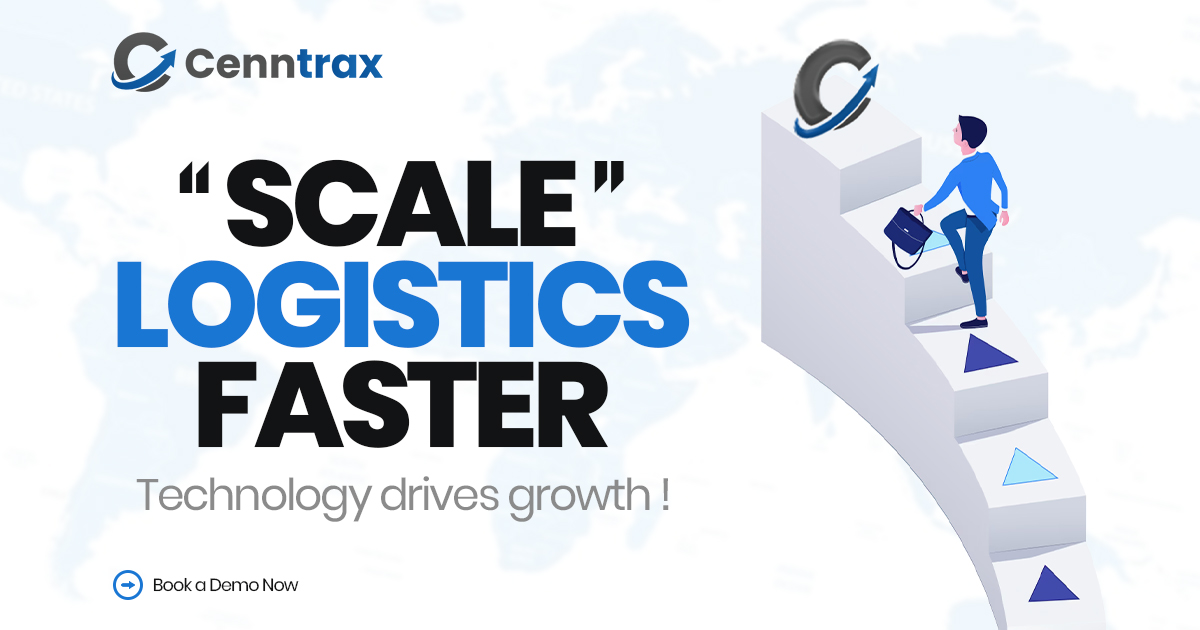
The logistics industry faces a persistent paradox: rapid growth often leads to operational breakdown. A company that runs smoothly at 1 million annual shipments struggles at 5 million. A logistics provider that delivers excellent service to 50 customers becomes unreliable at 500 customers. The very success that should propel growth instead creates operational crises.
This scaling problem is one of the most significant barriers to logistics company growth. Many entrepreneurs and logistics leaders have experienced it: They build a successful operation, begin to grow, and suddenly everything falls apart. Service levels deteriorate. Costs spiral. Customers churn. Growth stalls.
But it doesn't have to be this way. Technology solves the scaling problem. Companies like Cenntrax are enabling logistics operations to grow faster, more profitably, and more sustainably than ever before. The question is no longer whether you can scale logistics operations. The question is how quickly technology can enable that scaling.
THE SCALING PARADOX IN LOGISTICS
Traditional logistics operations scale poorly. Here's why:
Manual processes don't scale. When a warehouse is small, a single person can coordinate order picking manually. When that warehouse grows tenfold, manual coordination becomes impossible. Yet many logistics operations still rely on spreadsheets, phone calls, and manual coordination. These processes create the ceiling on growth.
Systems built for small operations crumble under growth. A dispatch system designed for 50 daily shipments might handle 500, but not 5,000. A warehouse management system built for one facility struggles with three facilities. Legacy systems have architectural limits. Reaching those limits forces expensive rebuilds or complete replacements.
People-dependent operations don't scale. Businesses built around key individuals hit scaling walls. When the best dispatcher leaves, performance collapses. When the warehouse manager retires, operations deteriorate. Growth requires systems and processes, not just talented people.
Fragmented systems create coordination nightmares. When each function—warehouse, dispatch, billing, customer communication—operates independently, coordination becomes increasingly difficult. Adding more volume compounds the coordination challenge. The system breaks under stress.
Cost structures don't improve with scale. Many logistics operations have costs that increase proportionally with volume. They need more warehouse space, more drivers, more staff. While revenue grows, so does cost, limiting margin improvement. Without operational leverage, profitable growth becomes impossible.
The traditional result is this: Companies grow until their operations can't handle the volume. Growth stalls. They stay at that level or regress. Competitors who solve the scaling problem overtake them.
THE GROWTH IMPERATIVE
Scaling is essential for logistics companies. Here's why:
Market expansion requires scale. Customers want regional or national coverage. Providing that coverage requires multiple facilities, diverse transportation networks, and complex operations. Companies that can't scale regionally get limited to local markets.
Customer consolidation demands scale. Large enterprises consolidate logistics partners. They don't want to work with 10 different 3PLs. They want one or two partners that can handle their entire national or international network. Only companies that scale can win these contracts.
Profitability improves with scale. Larger operations achieve operational leverage. Warehouse space costs less per shipment. Transportation networks optimize more effectively. Administrative costs spread across more volume. Companies that scale become more profitable.
Competitive survival requires scale. Competitors are scaling. The logistics market is consolidating. Companies that don't scale get acquired or driven out of business.
Investor capital demands scale. If you're seeking investment or planning an eventual exit, scale is essential. Investors value companies with demonstrated ability to grow.
The logistics companies winning in today's market are those that figured out how to scale. And the secret to their scaling is technology.
HOW TECHNOLOGY SOLVES THE SCALING PROBLEM
Cenntrax and modern logistics platforms solve scaling problems through fundamental architectural changes:
Automation replaces manual processes. When processes are automated, they scale linearly. Ten thousand shipments process with the same automation infrastructure as one thousand shipments. Labor costs per shipment decrease. Errors decrease. Processing speed increases. Automation is the foundation of scalable logistics.
Integrated systems eliminate fragmentation. Modern platforms integrate warehouse management, transportation management, billing, and customer communication into one unified system. This integration scales seamlessly. Adding new customers, facilities, or volume doesn't require new integrations or workarounds. The system scales elastically.
Intelligent algorithms optimize operations. Machine learning and optimization algorithms make decisions that improve with scale. Route optimization gets better with more shipments because the algorithms have more data. Demand forecasting improves. Pricing optimization improves. These algorithmic advantages compound as volume grows.
Cloud infrastructure scales elastically. Traditional IT infrastructure requires capacity planning and capital investment. Cloud infrastructure scales automatically. Need double the computing power? It scales instantly. Spike in volume on peak day? The system scales to handle it. This elasticity enables rapid growth without infrastructure planning.
Data-driven decisions enable efficiency. As volume grows, understanding performance becomes increasingly important. Technology platforms generate massive amounts of data. This data enables identification of inefficiencies, bottlenecks, and opportunities. Companies optimize based on data, not intuition.
Process standardization enables consistency. Technology enforces standardized processes. Every warehouse follows the same procedures. Every dispatch follows the same optimization logic. Every customer receives the same communication standards. This consistency enables growth without degradation of service.
Staff productivity improves through tools. Technology doesn't replace workers—it multiplies their effectiveness. A warehouse worker with intelligent picking tools can pick 20 percent more items. A dispatcher with route optimization tools can manage 50 percent more shipments. A customer service representative with visibility tools can resolve issues 30 percent faster. Better tools mean better productivity, which enables growth with proportional staffing increases rather than exponential ones.
SCALING CHALLENGES AND HOW TECHNOLOGY ADDRESSES THEM
Let's walk through specific scaling challenges and how Cenntrax and modern platforms address them:
Challenge: Warehouse Capacity Constraints
As volume grows, warehouses fill. Adding more warehouse space becomes necessary. But warehouse costs are high, and commitment is long-term. Real estate decisions constrain growth.
Technology solution: Cenntrax optimizes warehouse operations so existing space handles more volume. Intelligent inventory positioning puts fast-moving items in accessible locations. Wave planning coordinates picking and packing for maximum efficiency. Cross-docking eliminates storage requirements for certain shipments. Through optimization, existing warehouse space handles 20-30 percent more volume without expansion.
Additionally, better inventory data enables smarter stocking decisions. Instead of stocking everything centrally, inventory distributes to regional warehouses based on demand. This reduces overall inventory holding and facility requirements.
Challenge: Transportation Complexity
As volume grows, transportation networks become more complex. Managing multiple carriers, optimizing routes, coordinating pickups and deliveries becomes increasingly difficult.
Technology solution: Cenntrax automates transportation management. Route optimization happens automatically, optimizing thousands of routes daily. Carrier selection is data-driven based on performance metrics. Capacity planning aligns supply and demand. TMS automation enables the same team to manage exponentially more shipments.
Moreover, network optimization considers the entire supply chain. Should shipments consolidate at distribution centers? Ship direct? Use less-than-truckload or full-truckload? These decisions are optimized automatically, improving efficiency and enabling growth.
Challenge: Coordination and Communication
With more facilities, more carriers, and more customers, coordination becomes complex. Information flows between multiple systems and parties. Errors and miscommunications multiply.
Technology solution: Cenntrax creates a unified information ecosystem. All parties—warehouse, dispatch, carriers, customers—see consistent information. APIs integrate external systems. Communication workflows automate. When a warehouse completes an order, dispatch sees it immediately. When a carrier updates tracking, customers see it instantly. This unified communication scales beautifully.
Challenge: Visibility and Control
As operations grow, visibility becomes harder to maintain. Leaders can't see everything happening across multiple facilities, multiple carriers, multiple customers.
Technology solution: Cenntrax provides comprehensive dashboards and analytics. Leaders see real-time operational metrics across the entire network. Performance data surfaces bottlenecks and opportunities. Alerts notify leaders of problems requiring attention. Despite complexity, leaders maintain visibility and control.
Challenge: Service Consistency
Scaling often means adding new team members, new facilities, new carriers. Maintaining consistent service levels across this expanded operation is difficult. Quality sometimes deteriorates during growth.
Technology solution: Cenntrax enforces standardized processes. Service standards are built into the system. Every warehouse follows the same procedures. Every dispatch uses the same optimization logic. Every customer receives the same communication standards. As the operation grows, consistency is maintained rather than degraded.
Challenge: Cost Control
Scaling can be expensive. Facilities, equipment, staff, and systems all require investment. Many companies scale profitably. Others scale and watch margins deteriorate.
Technology solution: Cenntrax enables growth with improving unit economics. Automation reduces labor costs per shipment. Optimization reduces transportation costs. Better asset utilization reduces facility costs. Data-driven decision-making identifies cost reduction opportunities. As volume grows, cost per shipment decreases, improving profitability.
Challenge: Customer Expectations
As companies scale, larger customers with more sophisticated expectations arrive. These enterprise customers demand capabilities that smaller companies didn't require. Meeting these expectations becomes necessary to grow.
Technology solution: Cenntrax enables enterprise capabilities. Real-time visibility portals satisfy customer transparency demands. API integrations satisfy automation requirements. Advanced analytics satisfy data demands. Flexible service options satisfy operational demands. The platform scales from serving small customers to enterprise customers.
Challenge: Regulatory and Compliance Complexity
As companies scale geographically, regulatory requirements multiply. Different regions have different regulations. Compliance becomes increasingly complex.
Technology solution: Cenntrax enforces compliance rules at operational level. Requirements for different regions are configured in the system. Processes automatically comply with relevant regulations. Auditing and reporting become easier. Compliance scales with operations rather than becoming increasingly burdensome.
Challenge: Speed and Responsiveness
Growing companies often lose the speed and responsiveness that made them successful. Larger organizations move slower than smaller ones. But customers expect speed.
Technology solution: Cenntrax enables speed even at scale. Automated processes move faster than manual ones. Standardized procedures are executed quickly. Real-time data enables quick decisions. Communication is instantaneous. Companies can maintain startup-like speed even as they grow to enterprise scale.
THE FINANCIAL IMPACT OF TECHNOLOGY-ENABLED SCALING
The business impact of technology-enabled scaling is substantial:
Growth Rate Acceleration: Companies using modern platforms like Cenntrax grow faster. Their operations don't constrain growth. A logistics company that manually manages operations might grow 20 percent annually. The same company with Cenntrax can grow 50 percent annually because operations scale with growth.
Profitability Improvement: As companies scale using technology, profitability improves. Automation reduces labor costs. Optimization reduces transportation costs. Better asset utilization reduces facility costs. The result is improving margins as volume increases. Instead of margins compressing with growth, they expand.
Return on Investment in Technology: Cenntrax and similar platforms typically pay for themselves within 18-24 months through operational improvements. After payback, improvements flow directly to profitability. A company that spends $2 million annually on platform costs and gains $10 million in annual operational improvements has a compelling ROI.
Market Expansion Capability: Technology enables companies to compete in markets they previously couldn't serve. A 3PL with legacy systems might be limited to local markets. With Cenntrax, the same company can expand regionally and nationally. This market expansion drives revenue growth.
Premium Pricing Opportunity: Companies with superior operational capabilities can command premium pricing. Enterprise customers pay for reliability, visibility, and service quality. Technology-enabled companies provide these capabilities and capture the premium pricing.
Competitive Advantage Duration: Once established, technology-enabled advantage is difficult to copy. A competitor using legacy systems must undergo complete transformation. During that transformation period, the technology leader captures market share and grows faster.
REAL-WORLD SCALING EXAMPLES
Consider a mid-sized 3PL that scaled using technology:
Year 1: The company operates one facility with 10 million annual shipments. Manual processes work adequately. The company is profitable but not growing rapidly.
Year 2: The company decides to scale. They implement Cenntrax to optimize operations and add a second facility. Operations scale smoothly. Shipments grow to 18 million annually. The second facility reaches full productivity quickly because Cenntrax standardizes operations.
Year 3: The company adds two more facilities, expanding regional coverage. Customer base grows 40 percent. Shipments reach 35 million annually. Technology handles the complexity seamlessly.
Year 4: The company consolidates shipments across facilities, optimizes transportation networks, and automizes warehouse operations using Cenntrax intelligence. Shipments reach 60 million annually with better margins than Year 2 despite much higher volume.
Year 5: The company has scaled from one facility to four facilities, grown shipments from 10 million to 100 million annually, expanded customer base 5x, and improved margins from 8 percent to 12 percent. This growth would have been impossible without technology.
This company's success story is replicated across the industry. Companies that invest in modern technology scale faster and more profitably than those that don't.
SCALING CAPABILITIES OF CENNTRAX
Cenntrax enables scaling through specific capabilities:
Multi-Facility Management: Operate hundreds of facilities from one unified platform. Inventory visibility spans all facilities. Operations are coordinated across locations. Growth from one facility to many happens seamlessly.
Carrier Management and Network Optimization: Integrate dozens of carriers into optimized transportation networks. Route optimization spans multiple carriers. Capacity planning coordinates supply and demand. Transportation complexity is automated.
Customer Portal and Integration: Customers integrate directly with Cenntrax through APIs. As you gain new customers, the platform handles their unique integrations. Supporting different customer requirements doesn't require new development.
Advanced Analytics and Reporting: As volume grows, data grows. Advanced analytics turn massive data into insights. Reporting scales to handle thousands of KPIs.
Predictive Capabilities: Machine learning improves with more data. As volume grows, predictive analytics become more accurate. Demand forecasting, dynamic pricing, and risk prediction improve continuously.
Mobile and Remote Operations: Teams access the platform from anywhere. Growth doesn't require new office space. Remote teams operate efficiently through mobile access.
Workflow Automation: Repetitive processes are automated. As volume grows, automation handles the volume increase without proportional staff increases.
SCALING WITHOUT TECHNOLOGY: WHY IT FAILS
Some companies try to scale using traditional methods:
Hire more staff: Labor costs increase proportionally with volume. Margins don't improve. Training becomes difficult. Service quality often deteriorates. Scaling through staff increases hits economic limits quickly.
Build more facilities: Facility costs are high and fixed. Adding facilities requires long-term commitment. If growth slows, facilities become unprofitable. Capital requirements become substantial.
Acquire competitors: Acquiring other companies is expensive and risky. Integration is complex. Savings are often difficult to realize. Scaling through acquisition typically requires sufficient profitability to finance acquisitions, which must be reinvested.
Invest in custom software: Building custom technology is extremely expensive and time-consuming. Custom systems often lack the sophistication of purpose-built platforms. Maintenance and updates require ongoing investment.
These approaches have significant limitations. They constrain growth. They increase costs. They limit flexibility. Companies that rely solely on these methods struggle to compete with companies using modern platforms like Cenntrax.
THE COMPETITIVE DYNAMIC OF TECHNOLOGY-ENABLED SCALING
A powerful competitive dynamic emerges when companies use technology to scale:
Early mover advantage: The first company in a market to implement modern technology scales faster. They grow market share. By the time competitors respond, they've established position that's difficult to overcome.
Winner-take-most dynamics: In regional markets, scaling creates winner-take-most dynamics. The company that achieves regional scale first often dominates because customers prefer consolidation. Laggard competitors become acquisition targets.
Profitability advantage: Technology-enabled companies have better profitability. This enables investment in better technology, better talent, better service. The gap widens over time.
Valuation premium: Growing companies that demonstrate scaling capability command premium valuations. Investors pay for demonstrated ability to grow profitably. Technology-enabled companies demonstrate this capability.
The competitive result is clear: Companies that use technology to scale become dominant. Companies that don't become acquisition targets or exit the market.
THE IMPLEMENTATION ROADMAP
Companies looking to scale using technology should:
Assess Current State: Understand your current operations, technology, and performance. What's working? What's constraining growth? What would unlock faster scaling?
Define Growth Ambition: How fast do you want to grow? What new markets or customers do you want to serve? This shapes the technology requirements.
Select Technology Platform: A comprehensive platform like Cenntrax provides the foundation for scaled operations. Platform selection is critical—the right platform enables rapid growth; the wrong platform constrains it.
Plan Implementation: Technology implementation requires planning. Prioritize capabilities that unlock growth. Phase deployment so the organization can absorb change.
Train and Operationalize: Technology is only useful if people use it correctly. Training is essential. Processes must be designed around technology capabilities.
Optimize Continuously: Data reveals optimization opportunities. Continuously improve processes based on performance data. The best companies are always optimizing.
Expand Systematically: As you scale geographically, do so systematically. Each new market should build on lessons learned in previous markets.
THE FUTURE OF TECHNOLOGY-ENABLED SCALING
Scaling will continue to evolve:
Autonomous Logistics: AI and automation will enable autonomous decision-making. Route optimization, carrier selection, pricing decisions will all happen automatically. This compounds the scaling advantage of technology-enabled companies.
Predictive Scaling: Instead of reacting to growth, companies will predict it. Machine learning models will forecast growth. Capacity will be added preemptively. Scaling becomes smoother with predictive approaches.
Real-Time Optimization: Today, optimization happens daily or weekly. Tomorrow, it will happen continuously. The supply chain will optimize itself in real-time based on constantly changing conditions.
Ecosystem Integration: Logistics doesn't exist in isolation. Supply chains integrate manufacturers, retailers, 3PLs, carriers, and customers. The future is integrated ecosystems where all parties contribute data and benefit from collective optimization.
Sustainability at Scale: Scaling companies will optimize for sustainability, not just cost. Technology enables environmental optimization alongside economic optimization.
TAKING ACTION NOW
The window for technology-enabled scaling is open, but competition is intense. Companies that haven't yet invested in modern platforms should act quickly. The longer they wait, the further behind they fall.
For growing logistics companies, Cenntrax represents the opportunity to scale faster, more profitably, and more sustainably. It's the difference between growing 20 percent annually and growing 50 percent annually. It's the difference between margins compressing under growth and improving with scale. It's the difference between organic growth and market leadership.
The companies that will dominate logistics in the next five years are being built right now. They're the ones using technology like Cenntrax to scale. They'll have regional, national, and international presence. They'll have enterprise customer bases. They'll have profitability that funds further growth.
Companies that don't invest in technology scaling will be acquired, consolidated, or left behind.
CONCLUSION: THE SCALING IMPERATIVE
Technology drives growth. This isn't theoretical—it's observable fact across industries. The logistics companies scaling fastest are using modern platforms. The companies scaling slowest are using legacy systems.
Growth requires scalable operations. Scalable operations require modern technology. Cenntrax provides that technology. It enables automation, integration, optimization, and visibility at scale. It transforms scaling from a constraint into an opportunity.
For logistics entrepreneurs and leaders, the question is clear: How fast can you scale using modern technology? For most, the answer is: faster than they thought possible.
Cenntrax makes technology-enabled scaling achievable. The competitive landscape demands it. Customer expectations require it. Growth depends on it.
The time to act is now. The companies that build their scaling advantage today will dominate their markets tomorrow.
Ready to scale your logistics faster? Discover how Cenntrax enables rapid, profitable growth. Technology doesn't just drive growth—it enables the scaling that separates leaders from followers in logistics.